
Policy focus: Power Trends Report underscores energy concerns
The Partnership
June 12, 2025
Blog Categories
 This week, the New York Independent System Operator released its annual Power Trends report, which details the state of New York’s electric grid. The report’s findings are concerning and underscore the need for a more sensible approach to climate and energy policy. This week, the New York Independent System Operator released its annual Power Trends report, which details the state of New York’s electric grid. The report’s findings are concerning and underscore the need for a more sensible approach to climate and energy policy.
Why Do Employers Care? Ensuring adequate energy supply is an economic development imperative. To attract, retain, and grow businesses in our region, employers must have the confidence that the grid can supply their businesses’ energy demands. If not, they will look elsewhere. “Shrinking reliability margins” is not a phrase that inspires confidence in investors, site selectors, or Buffalonians in a blizzard. Demand Up, Supply Down Businesses are becoming increasingly energy intensive. Accordingly, there is considerably more demand on the grid than in prior years. The report notes: “requests from data centers, high-performance computing projects and chip manufacturing [have] grown dramatically in recent years. 19 projects are currently requesting to connect to the grid for a total incremental load of 3,000 MW. The timing of these projects will have major impacts on system risk, highlighting the need for large investment in energy infrastructure.” Moreover, as state climate policy aims to replace gas-powered equipment with electric (vehicles, appliances, heating systems, etc.), the demand for electricity will increase – and not just marginally. According to the report, if the state pursues full electrification, grid demands could double over the next twenty years. The need for power is higher than ever and will only grow. Meeting that demand will require a Herculean effort to expand the grid. However, New York is going in the wrong direction. According to the report, since 2019, New York has added 2,274 MW of generating capacity, but deactivated 4,315 MW – a net decrease of 2,041 MW. The decrease is because the state shuttered nuclear and natural gas electric generating facilities during this timeframe. Less Reliable Grid
Power producers and energy utilities are working overtime to address these challenges by adding new generating capacity, expanding transmission infrastructure, and promoting efficiency upgrades. However, sound public policymaking is needed to ensure energy remains affordable and reliable. How Should Policymakers Respond? The BNP’s energy advocacy is crafted with these grid realities in mind. Consistent with our Advocacy Agenda, lawmakers should:
Questions? Email Director of Government Affairs Josh Veronica at JVeronica@thepartnership.org. |
 The result of all of this: New York is experiencing
 Related Posts

Finance & Insurance Leaders Discuss the Future of the Industry
Blog Back to Our Blog Blog Categories The Buffalo Niagara Partnership convened leaders from across the region’s finance and insurance sectors on September 30 for the latest session of the BNP Industry Leaders Forum. The conversation was led by Chris Mueller, Director – Merrill Lynch Market Executive, who provided perspective on trends in wealth management…

Growing Buffalo Niagara’s Economy: Where We Are, Where We Want to Go and How We’ll Get There
Blog Back to Our Blog Blog Categories Buffalo Niagara has strong employers, significant assets and capable organizations working to move our region forward. What we lack is an employer-led, shared, and data-driven roadmap that helps us understand where we stand, where our greatest opportunities exist and how we can capitalize on those opportunities to grow…

A Changing U.S.-Canada Trade Relationship
Blog Back to Our Blog Blog Categories For businesses in the Buffalo Niagara region, Canada is not a distant international market, but a major part of our regional economy. Companies on both sides of the border share customers, suppliers, workers, transportation networks and supply chains, which means decisions made in Washington and Ottawa can quickly…
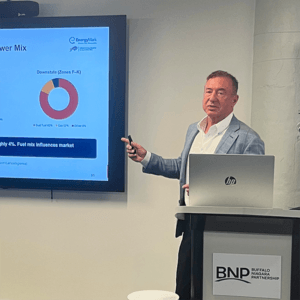
Powering Buffalo Niagara’s Future: Energy & Telecommunications Leaders Tackle Affordability, Infrastructure and Growth
Blog Back to Our Blog Blog Categories Reliable power. Affordable energy. Modern connectivity. All three will play a critical role in Buffalo Niagara’s ability to grow existing employers, attract new investment and compete in an increasingly technology-driven economy. That was the focus of the Buffalo Niagara Partnership’s 2026 Energy & Telecommunications Industry Leaders Forum, held…